Ingrown Hairs: Why Summer Makes Them Worse and What Works
Quick Answer: An ingrown hair is a hair that re-entered or curled back under the skin instead of growing out - and summer stacks the odds: more frequent hair removal, sweat-softened skin, tight swimsuits and shorts creating friction and occlusion. The fix stack: shave with the grain using a sharp blade, exfoliate chemically (salicylic or glycolic) two to three times weekly but never day-of, moisturize daily, give freshly-shaved zones 24 hours before tight synthetics - and for an existing bump, warm compresses and hands off. Recurrent, painful, or infected-looking cases belong with a provider.
The cruel math of summer: the season demanding the most hair removal is the season most hostile to smooth results. The bumps along the bikini line and shins are not bad luck or bad skin - they are a mechanical problem with a mechanical solution.

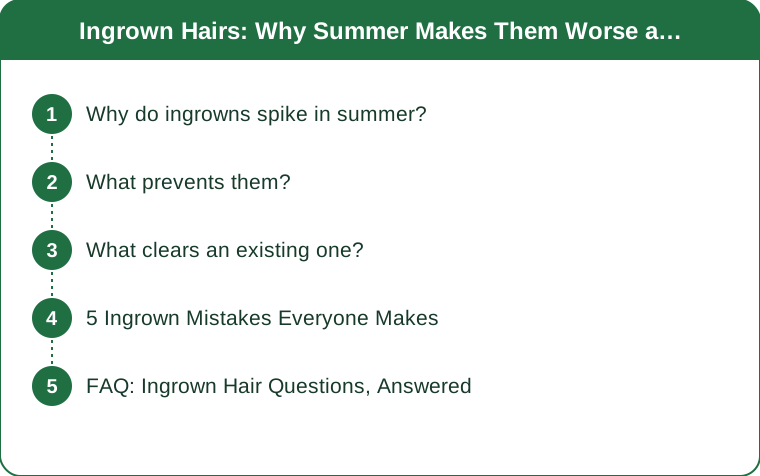
Why do ingrowns spike in summer?
Five factors, all seasonal, all stacking.
Removal frequency goes up. Beach weeks and shorts season push shaving from occasional to near-daily, and every removal event is a fresh set of sharp-tipped hairs at skin level - each one a candidate for re-entry. More attempts, more failures; the arithmetic alone explains half the season’s bumps.
A shaved hair tip is a spear. Cutting a hair at the surface leaves an angled, sharpened end - and as it grows, that tip can pierce back into the follicle wall or curve down into neighboring skin, especially when dead surface cells cap the exit. The body treats the re-entered hair as a foreign object: redness, a bump, sometimes a pustule. That inflammation is the ingrown.
Curl is destiny, and the bikini line has the most of it. Curly and coarse hair bends back toward skin naturally, which is why ingrowns concentrate along the bikini line and why curl-prone skin sees more of them everywhere. Geometry, not hygiene.
Sweat and heat soften and clog. Summer skin is damper, its surface more easily blocked by the mix of sweat, sunscreen, and dead cells - more capped exits for growing hairs to hit.
And tight fabric supplies the friction and occlusion. Swimsuit elastic, bike shorts, and snug waistbands press and rub exactly where removal happened, pushing hair tips sideways and holding heat and moisture against healing follicles. The post-shave beach day in a snug suit is, mechanically, the perfect ingrown factory.
Worth separating: widespread itchy bumps in a sweaty covered zone may be folliculitis - inflamed or infected follicles - rather than true ingrowns. The overlap is real, the care overlaps too, but persistent crops of pustules deserve a provider’s eye rather than a stronger scrub.
What prevents them?
Technique first, chemistry second, wardrobe third.
Prep like it matters, because it does. Remove hair at the end of a warm shower - softened hair cuts cleaner and lower-force. Cleanse first so the blade is not dragging through sunscreen residue, and use a real shave gel or cream, never dry or soap-scum passes.
Shave with the grain, sharp blade, light pressure. With-the-grain passes cut hair slightly longer with a blunter tip geometry - marginally less closeness, dramatically less re-entry. A sharp blade (replace after five to eight uses) cuts cleanly where a dull one tugs, tears, and leaves ragged tips. Skip the against-the-grain second pass on ingrown-prone zones entirely, and do not press - the closest possible shave is the highest-risk shave.
Chemical exfoliation is the maintenance engine. Salicylic acid (oil-soluble, gets into follicles) or glycolic acid, in a body lotion, wash, or pad form, used two to three times weekly on prone zones - it clears the dead-cell caps that block exits and keeps re-entry sites open. The timing rule: never on freshly-removed skin. Exfoliate the days between, not the day of.
Moisturize daily, even the oily-skinned. Dry, flaky skin builds exactly the surface layer hairs fail to pierce. Simple fragrance-free lotion after every shower converts the skin surface from barrier to exit.
Give shaved zones 24 breathable hours. Loose cotton over fresh removal; save the tight synthetics and swimsuit elastic for the next day when the follicles have settled. Scheduling removal the evening before the beach - rather than the morning of - is the single easiest calendar fix in this entire topic.
And consider the method switch for chronic zones. Trimming (no skin-level tip), depilatory creams (dissolved rounded tips - patch test first), or professional laser reduction (fewer hairs to ingrow at all) each sidestep the spear-tip problem that shaving inherently creates.

What clears an existing one?
Mostly restraint, strategically applied.
Hands off is rule one. Squeezing and digging with fingernails or tweezers traumatizes the follicle, drives inflammation deeper, invites infection, and is the leading cause of the dark marks that outlast the bump by months. The bump is annoying for days; post-inflammatory pigmentation is annoying for seasons.
Warm compresses do the honest work. A warm, damp cloth for five to ten minutes, twice daily, softens skin and encourages the hair to surface on its own - most ingrowns resolve this way within several days to a week or two.
Spot-treat the inflammation. A salicylic acid product on and around the bump keeps the surface clear while it resolves; a dab of over-the-counter hydrocortisone can calm an angry red one; benzoyl peroxide helps when a pustule is involved. Pause razor passes over the area until it settles - shaving over an inflamed bump restarts the clock and often nicks it.
The one permitted assist: if - and only if - the hair loop is visibly at the surface, a sterilized fine tweezer may gently lift the loop free so the tip exits the skin. Lift, do not pluck: fully removing the hair leaves the follicle to regrow a fresh spear from below, repeating the cycle. Anything requiring digging is not at the surface and is not eligible.
Know the escalation list. Increasing pain, spreading redness, warmth, pus beyond a pinpoint, a bump that hardens into a cyst, or the same spot cycling for weeks - that is provider territory, where options include proper drainage, prescription topicals, and a plan for the underlying pattern. Recurrent bikini-line cysts in particular deserve a professional conversation rather than a stronger home protocol, both to treat properly and to rule out look-alike conditions. General information, not medical advice.
5 Ingrown Mistakes Everyone Makes
1. The dry rush-job shave. No warm water, no slip, four fast passes before the pool - the highest ragged-tip production rate available, on the exact zones most prone to punish it. If there is no time to do the bikini line properly, a trimmer pass beats a bad razor pass every time.
2. Riding a dull blade for a month. A tugging blade tears hair into exactly the jagged tips that re-enter, and it takes more passes at more pressure to finish the job - three risk factors from one piece of neglected equipment. Five to eight uses, then swap; the cartridge budget is cheaper than the aftermath.
3. Scrubbing raw as treatment. Attacking existing bumps with rough physical scrubs and loofahs adds abrasion to inflammation, spreads any bacteria along the way, and worsens the pigmentation risk. The working version is chemical and gentle - acids dissolve the blockage without the friction. Physical exfoliation earns a place only as light maintenance on calm, intact skin.
4. Digging with whatever is sharp. Fingernails, sewing needles, aggressive tweezing below the surface - the fastest route from a one-week bump to a one-month wound with a souvenir mark. The surface-loop lift is the entire licensed toolkit; everything deeper belongs to a provider.
5. Exfoliating on shave day. Acid on freshly-razored skin stings, inflames, and compromises the exact barrier that needed to stay calm - and inflamed follicles trap hairs more readily. The rhythm that works: remove hair one day, moisturize daily, run the acid on the in-between days.
Bonus: skipping moisturizer because the zone feels oily. Oily and well-hydrated are different states; dehydrated skin over-produces surface cells, thickening the very layer hairs fail to exit. The plainest lotion in the aisle, daily, quietly prevents more ingrowns than any specialty serum.

FAQ: Ingrown Hair Questions, Answered
How long does an ingrown hair take to go away?
Most resolve on their own within a few days to two weeks, faster with twice-daily warm compresses and a salicylic spot treatment, slower with squeezing and picking - interference reliably converts a one-week bump into a multi-week mark. One that persists beyond a couple of weeks, hardens, or keeps recurring in the same spot is worth showing a provider.
Is salicylic acid or glycolic acid better for ingrowns?
Salicylic has the edge for prevention - it is oil-soluble, so it penetrates into follicles where the blockages actually form - while glycolic excels at general surface smoothing and the pigmentation left by old bumps. Either used consistently two to three times weekly beats both used sporadically, and plenty of body products now combine them.
Should I stop shaving if I keep getting ingrown hairs?
Not necessarily - most chronic cases improve dramatically with technique fixes alone: with-the-grain passes, sharp blades, real prep, between-day acids, daily moisturizer, and 24 hours before tight clothing. If a faithful month of that still fails a zone, that zone is a genuine candidate for trimming instead, depilatories, or laser reduction - the methods that never create a sharpened tip at all.
Do sugar scrubs help with ingrown hairs?
As occasional gentle maintenance on calm skin, they modestly help keep the surface clear. As treatment for active bumps, they backfire - abrasion on inflamed follicles deepens the irritation and the pigment risk. The evidence-aligned routine runs on chemical exfoliants for prevention, warm compresses for active bumps, and scrubs strictly as the supporting act.
TL;DR:
- Summer stacks the causes: frequent shaving, spear-tipped regrowth, sweat-clogged skin, tight hot fabric.
- Prevention: with-the-grain sharp-blade shaves, acids on the in-between days, moisturizer daily, 24 loose-clothed hours after.
- Active bumps get warm compresses and salicylic - never fingernails, needles, or below-surface tweezing.
- Only a visible surface loop may be lifted (not plucked) with a sterilized tweezer.
- Spreading redness, pus, cysts, or endless recurrence goes to a provider, not a harsher scrub.
The bikini-line bump was never a hygiene verdict. It is a geometry problem - a sharpened tip and a blocked exit - and both halves have boring, reliable fixes.
Keep Reading
This article is for general informational and styling purposes only. Fit, sizing, and product availability may vary.