5 Ways Your Hair Removal Routine Shifts as Summer Ends
Quick Answer: Cooler air, lower humidity, and less sun exposure change three things at once: skin barrier hydration drops, ingrown risk rises under heavier clothing, and the window for laser or IPL treatment opens because sun exposure falls. A routine that worked in July usually needs a moisturiser change, a longer interval, and a look at exfoliation.
The end of summer is the most under-discussed transition in body care. Nothing dramatic happens — but by mid-September a lot of people are dealing with more irritation, more ingrowns, and drier legs than they had in July, and they treat it as a product failure.
Here are the five shifts that actually explain it, and what each one asks you to change.

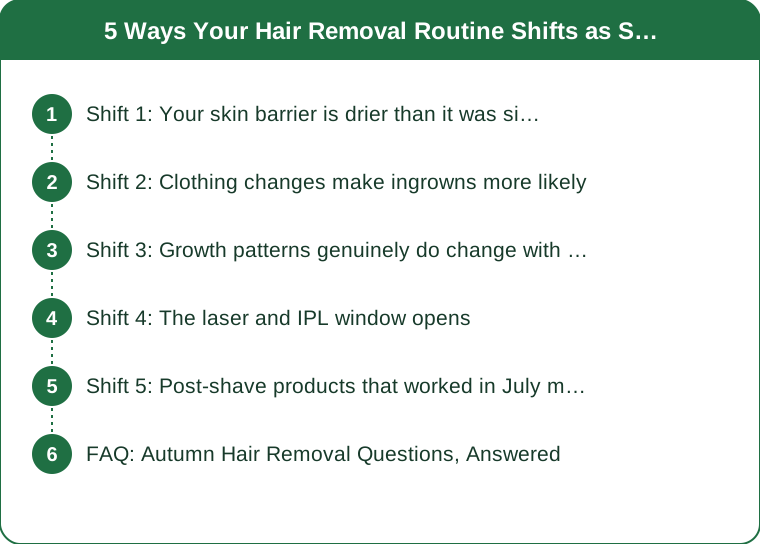
Shift 1: Your skin barrier is drier than it was six weeks ago
The first thing to change is not your razor. It is the state of the skin you are dragging it across.
As ambient temperature and humidity fall, transepidermal water loss increases and the stratum corneum holds less moisture. Drier skin is rougher, less pliable, and considerably more prone to micro-tears during shaving. It also produces more visible flaking, which makes freshly shaved skin look patchy and ashy in a way it did not in high summer.
Indoor heating, once it starts, accelerates this substantially — heated indoor air often sits below 30 percent relative humidity, which is drier than most deserts.
What to change: move from a light lotion to something with occlusive content, and apply it while skin is still damp from the shower. Ingredients worth looking for are glycerin and hyaluronic acid to draw water in, plus a lipid layer — ceramides, squalane, shea, or plain petrolatum on very dry patches — to hold it there.
Timing matters as much as product. Applying moisturiser within three minutes of towelling off traps considerably more water than applying it twenty minutes later. If you shave in the evening, that is when the moisturiser goes on.
Shift 2: Clothing changes make ingrowns more likely
Ingrown hairs are a friction-and-occlusion problem, and autumn brings substantially more of both.
Through summer, legs spend a lot of time uncovered or under loose fabric. From September onward they spend it under leggings, jeans, tights, and boots — closer-fitting, less breathable, and in constant contact with the skin during movement. Hair that is regrowing after shaving has a tapered, sharp tip and a slight curve, and pressure from clothing encourages it to re-enter the skin rather than emerge cleanly.
The areas that suffer most are exactly where clothing is tightest: the front of the thighs, the bikini line, and the back of the calves where boot shafts sit.
What to change: gentle chemical exfoliation two to three times a week — a lotion or pad with glycolic or salicylic acid — rather than aggressive scrubbing, which irritates already-dry skin. Give the areas under tightest clothing priority.
Also worth considering: shaving in the direction of growth for the first pass on high-friction areas. It gives a slightly less close result and a substantially lower ingrown rate, which is the right trade when the skin is going to be covered anyway.
Shift 3: Growth patterns genuinely do change with the season
Body hair growth is not perfectly constant across the year, and the shift shows up in how often you feel you need to remove it.
Hair grows in cycles, and the proportion of follicles in the active growing phase varies with a range of factors including light exposure and temperature. The effect on body hair is modest and varies considerably between individuals, but many people report needing to shave slightly less often as autumn progresses, and slightly more in high summer.
There is also a perception effect that is arguably larger than the biological one. In summer, legs are visible daily and under strong direct light, so regrowth is noticed at one day. Under tights and trousers in October, the same regrowth goes unnoticed for three.
What to change: let the interval extend rather than maintaining a summer schedule out of habit. Fewer passes over the same skin is the single most effective irritation reduction available, and it costs nothing.
For waxing specifically, the longer interval works in your favour — waxing needs about 5 mm of growth, which is easier to achieve without a visible awkward phase when nobody is seeing your legs anyway.

Shift 4: The laser and IPL window opens
This is the practical opportunity of the season, and it is time-sensitive.
Light-based hair removal targets pigment in the follicle. Tanned or recently sun-exposed skin has more pigment in the epidermis, which absorbs energy that was meant for the follicle — raising the risk of burns and pigmentary changes, and forcing practitioners to use lower, less effective settings. Most clinics require several weeks without meaningful sun exposure before treating, and most recommend avoiding sun between sessions.
That makes autumn and winter the natural treatment season. A full course typically runs six to eight sessions spaced four to eight weeks apart, which means starting in September puts you at the end of a course by roughly March — with the added benefit that your skin is at its least tanned throughout.
What to change: if this has been on your list, September is when to book the consultation rather than March. Starting in spring means either compressing the course or carrying it through the sunniest months.
Between sessions, sunscreen on treated areas still matters on bright days, and so does skipping waxing and epilating — light treatments need the follicle intact, so shaving is the only compatible method during a course.
Shift 5: Post-shave products that worked in July may now sting
The last shift is the one people notice first and understand least.
Alcohol-based aftershave splashes, strong astringents, and heavily fragranced body sprays are tolerable on well-hydrated summer skin and genuinely uncomfortable on a compromised autumn barrier. The formula did not change. The skin it is landing on has less lipid content and a less intact barrier, so more of the irritant reaches living tissue.
The same applies to exfoliating acids at summer strength, and to very hot showers, which strip surface lipids far more effectively than warm ones.
What to change: swap alcohol-forward products for a fragrance-free balm or a light ceramide lotion for the first hour after shaving, then return to whatever you like once the skin has settled. Drop shower temperature by a few degrees — a change most people find they stop noticing within a week.
If irritation persists despite these changes, look at the blade. A cartridge used more than five or six times pulls rather than cuts, and a dull blade on dry autumn skin produces exactly the burning, bumpy result that gets blamed on products.
Quick reference for the season
- Moisturise within 3 minutes of the shower, with a lipid-containing formula
- Exfoliate gently 2–3 times a week, prioritising areas under tight clothing
- Extend the interval between removals rather than keeping summer frequency
- Book light-based treatments now, while sun exposure is low
- Replace blades every 5–6 uses and drop the water temperature
FAQ: Autumn Hair Removal Questions, Answered
Should I switch from shaving to waxing for the winter?
It is a reasonable time to try, because the awkward growing-out phase is hidden and the longer intervals suit the season. Waxing removes hair at the root, so regrowth is finer and slower, but it needs 5 mm of growth and does temporarily compromise the skin barrier — so the moisturising advice above matters more, not less.
Why do I get more razor burn in winter than summer?
Almost always drier skin plus hotter showers plus longer blade life. Fix those three in order and most winter razor burn resolves without changing anything about your technique.
Are ingrown hairs ever something to see a doctor about?
Yes — if a lesion becomes large, painful, filled with pus, or spreads, it may be folliculitis or an infection that needs treatment. Recurrent severe ingrowns, particularly in the bikini area or on the face and neck, are also worth a dermatology appointment because there are prescription options that work well. This is general information, not medical advice.
TL;DR:
- Cooler, drier air weakens the skin barrier — moisturise within three minutes of showering, with lipids not just water-binders.
- Tighter autumn clothing raises ingrown risk; gentle chemical exfoliation beats scrubbing on dry skin.
- Let intervals extend instead of holding a summer schedule; fewer passes means less irritation.
- Autumn is the right window to start laser or IPL, and the wrong season for alcohol-based aftershave products.
The season changes underneath the routine, which is why a routine that never changed starts feeling like it stopped working. Adjust five things now and September looks after itself.
Keep Reading
This article is for general informational and styling purposes only. Fit, sizing, and product availability may vary.