5 Hair Removal Changes Worth Making at the End of Summer
Quick Answer: Autumn is the better half of the year for hair removal, and the transition point is now. Laser and IPL work best on skin without a tan, so the window opens as the tan fades - and it takes several sessions spaced weeks apart, so starting in autumn means being finished by spring. Skin is more fragile after a summer of sun, so waxing and epilating need a recovery period first. And the reasons to shave daily disappear as clothing covers more, which is a genuine opportunity to let irritated skin heal. Here are the five changes worth making.
A summer of frequent shaving, chlorine, sun and sand leaves most people’s skin in worse shape than they realize.
Late August is the natural reset, and five specific changes make the next six months considerably better than the last three.
This is general information, not medical advice.

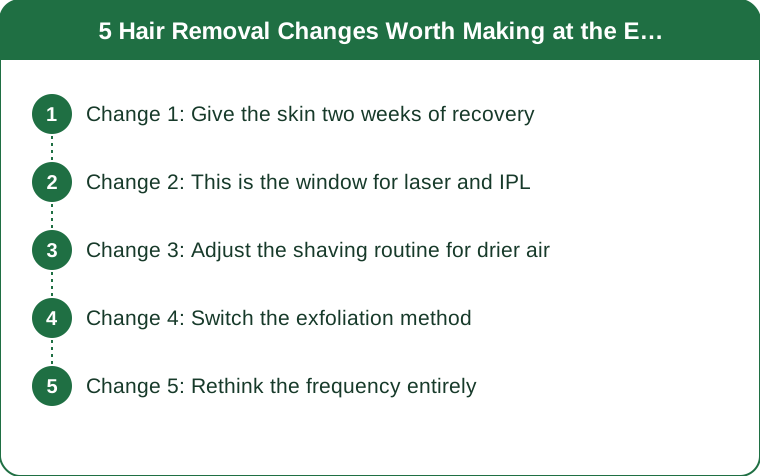
Change 1: Give the skin two weeks of recovery
Before you change any method, stop for a bit.
Summer skin has been through UV exposure, chlorine, salt, sand abrasion and frequent shaving - and shaving is itself a form of physical exfoliation that removes the top layer of the stratum corneum along with the hair.
The combined result is a compromised barrier, which is why razor burn, ingrown hairs and general irritation all peak at the end of summer even for people whose technique has not changed.
A two-week break from any hair removal is the single most useful thing you can do right now. Late August into September is the easiest time to do it - clothing covers more, the social pressure drops, and nobody is looking.
During the break: moisturize daily, use a gentle chemical exfoliant two or three times a week rather than a scrub, and leave existing ingrown hairs alone rather than picking them.
Do not extract ingrown hairs. It introduces bacteria and produces post-inflammatory pigmentation that lasts far longer than the ingrown would have. A warm compress and a gentle chemical exfoliant - glycolic or salicylic acid - resolves most of them without a mark.
When you resume, the skin will tolerate whatever method you choose considerably better than it does today.
Change 2: This is the window for laser and IPL
Autumn is the correct season to start, and the reason is physical.
Laser and IPL work by targeting melanin in the hair follicle and converting light energy to heat. The problem with treating tanned skin is that the melanin in the skin absorbs the same energy, which both reduces effectiveness and raises the risk of burns and pigment changes.
This is why practitioners ask about recent sun exposure and why treatment on tanned skin is either declined or done at reduced settings that work less well.
A tan needs to fade before treatment, which for most people means several weeks after the last significant exposure. Late August into September is when that window opens.
The other reason autumn is right is the schedule. A course typically requires six to eight sessions spaced four to eight weeks apart, because the treatment only works on follicles in the active growth phase and only a proportion are in that phase at any time.
Starting in September means finishing around spring, with minimal sun exposure through the whole course - which is exactly what the aftercare requires. Starting in April means the last sessions land in peak summer, which is the wrong way around.
Realistic expectations matter: this is long-term reduction rather than permanent removal, results vary substantially with hair color and skin tone, and maintenance sessions are usually needed. Consult a qualified practitioner for advice specific to your skin.

Change 3: Adjust the shaving routine for drier air
The same routine gets more irritating as humidity falls.
Shaving removes both hair and a layer of the skin’s surface, and the drier the skin, the more that removal is felt. Autumn air, plus indoor heating starting in the coming weeks, produces the classic seasonal pattern of razor burn appearing in a routine that had been fine.
Five adjustments that matter:
Shave at the end of a shower, not the start. Hair absorbs water and softens over a few minutes, and softer hair cuts with less pull.
Use an actual shaving product, not soap or body wash. Soap strips lipids and provides poor glide - it is the most common cause of irritation in an otherwise fine routine.
Change the blade more often than feels necessary. A dull blade requires more passes and more pressure, and both cause irritation. A blade that has been through a summer of chlorine has corroded faster than usual.
Shave with the grain if you are prone to ingrowns. Against the grain is closer and considerably more likely to produce ingrown hairs, particularly in coarse or curly hair.
Moisturize immediately after, on damp skin, with something without fragrance or alcohol. This is the step that people skip and it does more than the rest combined.
Change 4: Switch the exfoliation method
Physical scrubs are the wrong tool for the season.
Exfoliation genuinely prevents ingrown hairs by clearing the dead skin that traps the emerging hair. But scrubs do it through abrasion, and abrasion on a summer-compromised barrier adds to the problem it is meant to solve.
Chemical exfoliation is the better approach, particularly now. Glycolic acid works on the surface layer and is good for general smoothness. Salicylic acid is oil-soluble, so it penetrates into the follicle itself, which is why it is the more effective choice specifically for ingrown hairs and for the bumpy texture on the backs of arms and thighs.
Two or three times a week is enough, applied to clean dry skin and left on. Not immediately after shaving - wait at least a day, because acid on freshly shaved skin stings considerably and adds irritation.
The timing rule that works: exfoliate the day before you shave, not the day after. This clears the path for the emerging hair without applying acid to freshly abraded skin.
And give it time. Ingrown hair patterns take four to six weeks to improve with consistent exfoliation, because you are affecting hairs that are already in the follicle. Judging it after one week is judging too early.
Change 5: Rethink the frequency entirely
Autumn is when the routine can genuinely relax, and that is worth taking.
Most people shave far more often in summer than the hair requires, driven by clothing and visibility rather than by growth. As clothing covers more, the frequency can drop substantially - and reduced frequency is the most effective irritation treatment there is.
This is also the right season to try a different method without the pressure of immediate results.
Waxing and epilating both remove hair from the root and produce a longer interval - typically three to four weeks - but they require growth of a few millimeters before each session, which is much easier to accommodate in autumn than in summer. Do not start either while the skin is still recovering from summer; wait until after the two-week break.
Trimming rather than removing is an option people rarely consider and which eliminates ingrown hairs entirely, since the hair is never cut below the skin surface.
And doing nothing is a legitimate choice for the areas that will be covered until spring. The skin recovers, ingrown hairs resolve, and the follicles get a genuine break.
Whatever you choose, the decision is easier to make in September than in May - which is precisely why this is the month to make it.
This is general information, not medical advice. Persistent folliculitis, cysts, or skin that does not settle with a break deserve a clinical opinion.
TL;DR:
- Take two weeks off before changing anything - summer skin needs the recovery more than a new method.
- Autumn is the laser and IPL window: a tan interferes with the treatment, and a six-to-eight session course started now finishes before summer.
- Adjust shaving for drier air: end of shower, real shaving product, fresh blade, with the grain, moisturize immediately.
- Swap scrubs for chemical exfoliants - salicylic acid for ingrowns specifically, the day before shaving rather than after.
- Reduce the frequency. Covered skin means the routine can relax, and less frequent removal is the best irritation treatment available.
- Never extract an ingrown hair - a warm compress and an acid resolve it without the pigment mark.
This is general information, not medical advice. The six months from now are the easy half of the year for this - use them.
Keep Reading
This article is for general informational and styling purposes only. Fit, sizing, and product availability may vary.