5 Post-Shave Reactions and What Each One Is Actually Telling You
Quick Answer: Immediate stinging redness that fades within an hour is friction irritation and points to blade drag. Small raised bumps appearing a day or two later are ingrown hairs and point to technique or hair type. A rash of tiny uniform dots right after is folliculitis. Flaky tightness is barrier dryness from the product, not the blade. And a persistent gray shadow is not stubble at all, it is refracted hair below the surface.
Each one has a different cause, so treating them all with the same aftershave balm fixes about one in five.

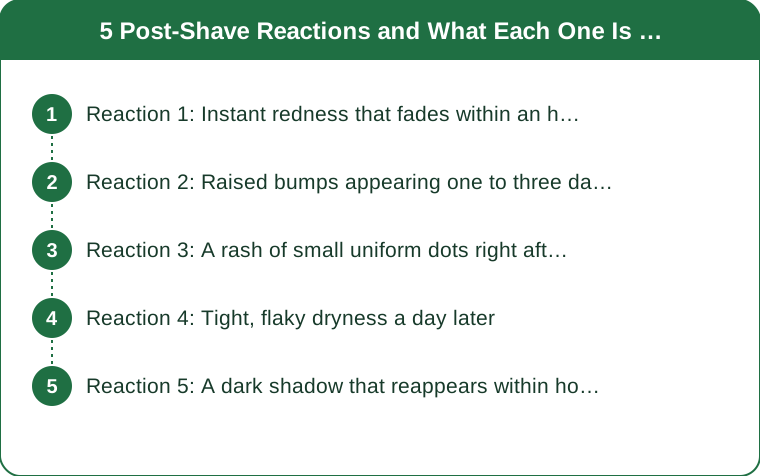
Reaction 1: Instant redness that fades within an hour
This is friction irritation, and it is the most common reaction by a wide margin.
What is happening: the blade is scraping skin rather than gliding over a lubricated surface. Every pass removes a small amount of the outermost skin layer along with the hair, and when there is not enough slip, several passes over the same patch remove considerably more.
How to tell it apart: it appears within seconds to minutes, it is diffuse rather than spotted, it feels hot, and it settles substantially inside 60 minutes.
The fix is almost entirely mechanical. Reduce passes to one per area — going back over the same stretch four times is where most of the damage happens. Use a genuine shaving product rather than body wash, which is formulated to remove oil rather than provide cushion. And replace the blade earlier than feels necessary; a blade past roughly five to seven shaves drags noticeably even when it still looks fine.
What does not help: pressing harder to get closer. Pressure increases skin removal without meaningfully improving closeness, because closeness is a function of blade sharpness and hair angle, not force.
Reaction 2: Raised bumps appearing one to three days later
Delayed timing is the giveaway. These are ingrown hairs, and the blade is only part of the story.
What is happening: a hair cut at a sharp angle below the skin surface re-enters the skin as it grows, or grows sideways under a layer of dead cells that never got cleared. The body treats the trapped hair as a foreign object and the resulting bump is an inflammatory response, not an infection.
Who gets them most: anyone with curly or coarse hair, where the natural growth curve makes re-entry far more likely. Body area matters too — bikini line, underarms and the back of the neck are the usual suspects because hair there grows in multiple directions.
The fix runs on a schedule, not on a product. Exfoliate gently two to three times a week, but never on the day of shaving. A chemical exfoliant with salicylic or glycolic acid clears the dead-cell layer more evenly than a scrub and without adding friction to already-stressed skin.
And the technique change that matters most: shave with the grain, not against it. Against-the-grain shaving cuts hair below the skin surface at a sharper point, which is precisely the setup for re-entry. You lose a small amount of smoothness and avoid most of the bumps.

Reaction 3: A rash of small uniform dots right after shaving
Uniform, follicle-centered and appearing quickly points to folliculitis rather than either of the first two.
What is happening: bacteria that live harmlessly on the skin surface get into freshly opened follicles. Every shave creates hundreds of tiny entry points at once, and warm damp conditions afterwards make it easy for them to be used.
How to tell it apart from ingrowns: ingrowns are scattered, variable in size, and often have a visible dark hair inside. Folliculitis dots are small, numerous, evenly sized and centered exactly on follicle openings.
The three habits that cause most of it:
- Shaving and then immediately putting on tight, non-breathable clothing. Leggings straight after a bikini-line shave is the textbook version.
- Using a razor stored in a wet shower, where a permanently damp blade and handle is an excellent bacterial environment.
- Shaving right before a workout, a sauna or a pool.
What to do about it: keep the area clean and dry for a few hours after shaving, store the razor somewhere it can dry fully, and shave in the evening rather than the morning when you can. If dots persist beyond a week, spread, or become painful and pus-filled, that is a reason to see a clinician rather than to keep experimenting. This is general information, not medical advice.
Reaction 4: Tight, flaky dryness a day later
This one is usually not caused by the blade at all.
What is happening: shaving is a form of physical exfoliation whether you intend it that way or not, and it removes a portion of the lipid layer along with the hair. Add a foaming product with a high surfactant load, hot water, and an alcohol-containing aftershave, and the barrier does not have the materials to rebuild.
How to tell it apart: no redness, no bumps, just tightness and fine flaking that appears a day or so later and often gets worse with each shave in a week.
The fix is subtractive. Look at what you are already using before adding anything:
- Swap a high-foam shave gel for a cream or oil-based product. Dense foam feels effective and is mostly air.
- Turn the water temperature down. Hot water strips lipids faster than anything else in the routine.
- Cut any product with denatured alcohol high on the ingredient list.
Then add one thing, not four. A simple moisturizer with ceramides or glycerin applied while skin is still slightly damp does more than a stack of specialty post-shave treatments. Late summer makes this worse in an underrated way — air conditioning runs constantly, and consistently dehumidified indoor air compounds a barrier that is already working to recover.

Reaction 5: A dark shadow that reappears within hours
The frustrating one, and the one that is not a reaction at all.
What is happening: you are seeing the hair shaft through the skin. Shaving cuts hair at the surface, which means the darker, thicker base of each shaft sits just below, visible through the semi-translucent top layer. This is why the shadow appears fastest on areas with coarse dark hair against lighter skin.
What it is not: it is not stubble growing back in four hours, it is not hair growing back thicker, and it is not a sign you shaved incorrectly. Hair growth rate on the legs averages roughly a third of a millimetre a day, which does not produce visible stubble by lunchtime.
What actually reduces it:
- Methods that remove hair from the root — waxing, sugaring, epilating. There is no shaft left below the surface to show through, which is why the shadow disappears entirely rather than being reduced.
- Light-based methods over a full course of sessions, which reduce hair density and coarseness rather than cutting it.
- Gentle exfoliation, which slightly improves clarity of the surface layer. A small effect, but real.
What does not work: shaving more often, shaving more aggressively, or switching razor brands. If the shadow is what bothers you most, the answer is a different category of method, not a better version of the same one.
FAQ: Post-Shave Reaction Questions, Answered
Can I use hydrocortisone cream on razor burn?
A low-strength over-the-counter version can calm short-term friction irritation, but it is not a routine product — repeated use on the same area thins skin over time. If you need it more than occasionally, the technique is the thing to fix.
How long should I wait to shave after a beach day?
Give sun-exposed skin at least 24 hours, and longer if there is any pink. Shaving over sunburned skin removes an already-damaged surface layer and reliably produces the worst version of reaction one.
Does shaving at night really help?
It does, for two of the five reactions. It gives follicles several hours to close before you put on tight clothing or sweat, which cuts both folliculitis and friction irritation.
TL;DR:
- Instant fading redness is friction — fewer passes, a real shave product, a fresher blade.
- Bumps a day or two later are ingrowns — shave with the grain and exfoliate on off days.
- Uniform dots right after are folliculitis — dry the area, dry the razor, skip tight clothes.
- Flaky tightness is barrier dryness from your products, not the blade.
- A dark shadow is the hair shaft seen through skin, and only root-level methods remove it.
Match the reaction to the cause before you buy anything. Four out of five of these are fixed by changing something you are already doing rather than adding a step.
Keep Reading
This article is for general informational and styling purposes only. Fit, sizing, and product availability may vary.