5 Hair Removal Adjustments the Cold Months Require
Quick Answer: Cold weather changes hair removal in five specific ways: skin is drier so shaving irritates more, ingrowns increase under thicker clothing, laser and IPL become easier as tans fade, waxing timing changes with slower regrowth, and post-removal care needs to shift from cooling to occlusive. Each has a distinct fix, and the biggest single change is moisturising differently rather than removing hair differently.
The season’s real advantage: reduced sun exposure makes autumn the best window of the year to start laser or IPL.

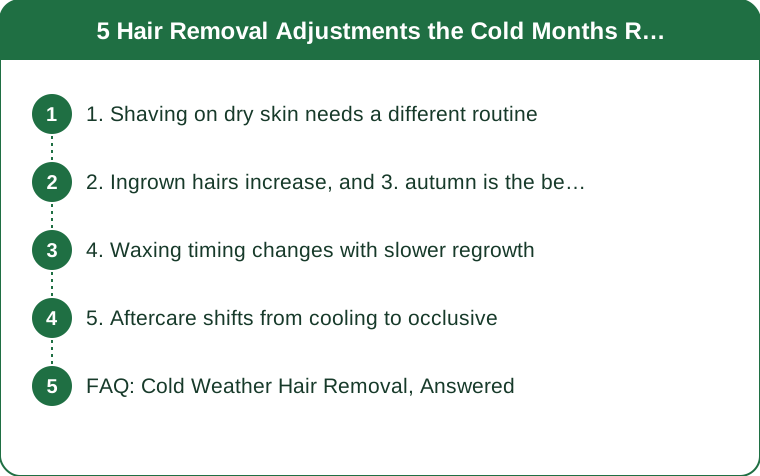
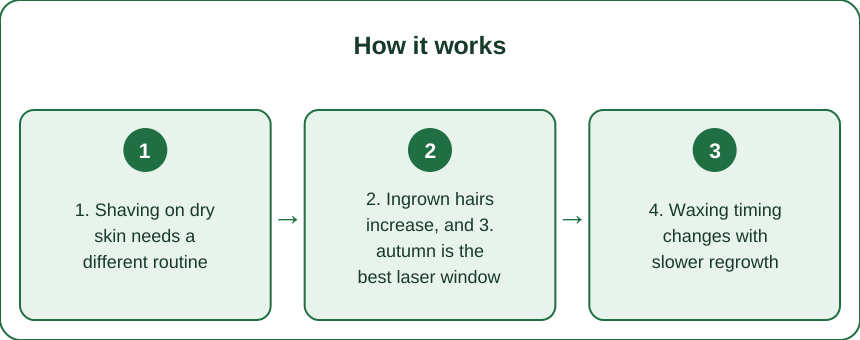
1. Shaving on dry skin needs a different routine
The razor did not change, the surface it is running over did.
Why shaving irritates more in cold months. Indoor heating drops humidity to 20 to 30 percent, and skin loses water continuously. A dehydrated stratum corneum is rougher, less pliable, and more easily disrupted - so the same blade at the same pressure causes more micro-trauma.
What changes and how it shows:
- More razor burn, particularly on legs and the bikini line
- Dry, ashy-looking skin immediately after shaving
- Increased stinging from any product applied afterwards
- Small nicks that take longer to heal in dry conditions
The adjusted routine:
- Shave at the end of a shower, not the start. 3 to 5 minutes of warm water softens hair substantially, which reduces the force needed
- Use a shaving cream or oil, never soap. Soap dries the skin further and provides poor glide - this is the most common winter shaving mistake
- Change blades more often. A dull blade requires more pressure, and pressure is what causes irritation on dry skin. Every 5 to 7 shaves
- Shave with the grain if irritation is a problem. Slightly less close, considerably less irritation
- Rinse in cool water at the end, which helps close the follicle
- Moisturise within three minutes, while skin is still damp
Frequency, which most people do not adjust. Hair growth slows slightly in cold months for many people, and shaving less often gives skin recovery time. If irritation is a problem, extending from every two days to every three or four helps more than any product change.
2. Ingrown hairs increase, and 3. autumn is the best laser window
2. Why ingrowns spike in cold weather.
Three things converge:
- Dry skin means more dead cell build-up at the follicle opening, which physically blocks emerging hair
- Thicker, tighter clothing - jeans, leggings, thermals - increases friction and presses hair back into the follicle
- Less exfoliation happens naturally, since people shower faster and skip the routines that summer encouraged
The prevention routine:
- Exfoliate 2 to 3 times a week, not daily. Daily exfoliation on dry winter skin causes the irritation you are trying to prevent
- Chemical exfoliation beats physical in cold months - a lotion with glycolic or salicylic acid is gentler than a scrub on dehydrated skin
- Exfoliate the day before removing hair, not the same day. Same-day exfoliation plus shaving is too much disruption at once
- Loose clothing for a few hours after hair removal, where practical
- Moisturise consistently, since supple skin allows hair to emerge more easily
What not to do with an ingrown: do not dig it out. That causes scarring and infection risk. Warm compress, gentle exfoliation around the area, and patience. An infected or persistently painful ingrown should be seen by a doctor.
3. Why autumn is the best time to start laser or IPL.
The reason is sun exposure, which is the main constraint.
- Both target melanin, so a tan increases the risk of burns and pigment changes. Treatment on tanned skin is riskier and often refused
- Most protocols require avoiding sun for a period before and after each session
- Autumn and winter make that straightforward rather than a constant negotiation
Timing the course:
- A full course is typically 6 to 8 sessions, 4 to 6 weeks apart - roughly 6 to 9 months
- Starting in autumn means finishing before the following summer, which is exactly the point
- Sessions must align with the growth cycle, which is why the spacing is not arbitrary
What is realistic: substantial permanent reduction rather than complete removal, best results on dark hair against lighter skin, and poor results on grey, white, blonde, or red hair, which lack the melanin the technology targets. Home IPL devices are lower powered and need more sessions, with more modest results.
4. Waxing timing changes with slower regrowth
The intervals that worked in summer produce a frustrating result in winter.
Why regrowth slows. Hair growth rate varies seasonally for many people, typically slowing modestly in cold months. Combined with covering up more, the pressure to maintain a schedule drops - and this creates a specific problem.
The waxing length requirement, which does not change:
- Hair needs to be roughly 5mm for wax to grip properly
- Too short and it does not grip, producing patchy results and a wasted appointment
- Too long and it hurts more and breaks rather than pulling from the root
How the interval shifts:
- Summer: typically every 3 to 4 weeks
- Winter: often 4 to 6 weeks as growth slows
- Judge by hair length, not by the calendar. Booking on a fixed schedule is why winter appointments produce patchy results
The consistency point that matters long-term. Regular waxing over time can lead to finer, sparser regrowth as follicles are repeatedly disrupted. Letting the routine lapse through winter and restarting in spring loses that benefit, and the first spring wax is more uncomfortable because the hair has returned to full thickness.
Winter waxing adjustments:
- Moisturise consistently between appointments but not on the day - wax does not adhere to moisturised skin
- Exfoliate 24 to 48 hours before, not on the day
- Expect more sensitivity. Dry skin is more reactive to the pull, and lifting can be more uncomfortable
- Aftercare needs to be richer than the light gels used in summer
On sugaring as a winter alternative. Sugaring paste adheres to hair rather than skin, which means less skin trauma - a meaningful advantage on dry winter skin. It also works on slightly shorter hair, which helps when growth is slow. Worth trying if waxing has become uncomfortable this season.
5. Aftercare shifts from cooling to occlusive
This is the change that fixes the most problems and the one people never make.
Why summer aftercare fails in winter. Summer aftercare is about cooling and calming - aloe gels, light lotions, witch hazel. Winter aftercare needs to be about sealing moisture in, which is a different job requiring different products.
What to use instead:
- A rich, fragrance-free cream rather than a lotion. Lotions are mostly water and evaporate
- Ceramide-containing products, which support barrier repair directly
- An occlusive layer at night on badly affected areas. A thin layer of petrolatum over cream retains water overnight
- Avoid anything with alcohol. Many aftershave and post-wax products are alcohol-based and are actively wrong on dry skin
The timing that matters. Apply within three minutes of patting dry, while skin is still slightly damp. This window genuinely affects how much water is retained - the same product applied twenty minutes later does considerably less.
The full winter sequence:
- Remove hair at the end of a warm - not hot - shower
- Rinse in cool water
- Pat dry, do not rub
- Apply a rich moisturiser within three minutes
- Loose clothing for a few hours where practical
- Reapply moisturiser before bed
What to avoid for 24 hours after any hair removal:
- Hot baths and saunas, which irritate freshly disrupted skin
- Exfoliation, which is too much at once
- Retinoids or acids on the area
- Tight synthetic clothing, which traps heat and increases friction
- Heavily fragranced products, which are the most common source of post-removal irritation
When to see a doctor: spreading redness, warmth, pus, or increasing pain suggests infection. Persistent folliculitis, or ingrowns that recur in the same place, is worth having assessed - there are effective treatments. This is general information, not medical advice.
FAQ: Cold Weather Hair Removal, Answered
Why does shaving irritate more in winter?
Because indoor heating drops humidity to 20 to 30 percent and skin loses water continuously. A dehydrated surface is rougher and more easily disrupted, so the same blade causes more micro-trauma. Use oil or cream rather than soap, change blades every 5 to 7 shaves, and moisturise within three minutes.
Why do I get more ingrown hairs in cold months?
Dry skin builds up more dead cells at the follicle opening, and thicker tighter clothing presses emerging hair back in. Exfoliate chemically 2 to 3 times a week - not daily, and not on the same day you remove hair.
Is autumn really the best time to start laser hair removal?
Yes. Both laser and IPL target melanin, so tanned skin raises the risk of burns and pigment changes. Autumn and winter make the required sun avoidance straightforward, and a 6 to 9 month course started now finishes before summer.
How often should I wax in winter?
By hair length rather than by the calendar - typically every 4 to 6 weeks rather than 3 to 4, because growth slows. Hair needs to be about 5mm for wax to grip properly. Booking on a fixed schedule is why winter appointments come out patchy.
What should I use after hair removal in winter?
A rich fragrance-free cream with ceramides, applied within three minutes of patting dry. Not the cooling gels and light lotions that work in summer - those evaporate. Avoid anything with alcohol.
Can I exfoliate and shave on the same day?
Better not to in cold months. Exfoliate 24 to 48 hours beforehand. Doing both at once is too much barrier disruption on already-dry skin and is a common cause of winter irritation.
TL;DR:
- Dry skin makes shaving irritate more - use oil or cream not soap, change blades every 5 to 7 shaves, shave at the end of the shower
- Ingrowns rise from dry build-up plus tighter clothing - exfoliate chemically 2 to 3 times weekly, never the same day
- Autumn is the best window to start laser or IPL because sun avoidance is easy and a course finishes before summer
- Wax by hair length, not the calendar - roughly 4 to 6 weeks as winter growth slows
- Swap cooling aftercare for occlusive: a rich ceramide cream within three minutes, no alcohol
The biggest single change is how you moisturise, not how you remove hair. Get that right and four of the five problems shrink on their own. This is general information, not medical advice.
Keep Reading
This article is for general informational and styling purposes only. Fit, sizing, and product availability may vary.