5 Facial Hair Removal Methods and What Each One Actually Suits
Quick Answer: Facial hair removal is not a scaled-down version of body hair removal. The skin is thinner, it is exposed to sun and skincare actives daily, and any reaction is visible. The five main options each suit different situations: dermaplaning for fine vellus hair and texture, threading for shaping brows and precise areas, waxing for speed on the upper lip and chin, at-home facial razors for maintenance between everything else, and laser or IPL for coarse dark hair on a lasting basis. The rule that applies to all five: stop retinoids and exfoliating acids for several days beforehand, or you will lift skin along with the hair.
Below, each method with what it suits, what it does not, and the mistake people make with it.

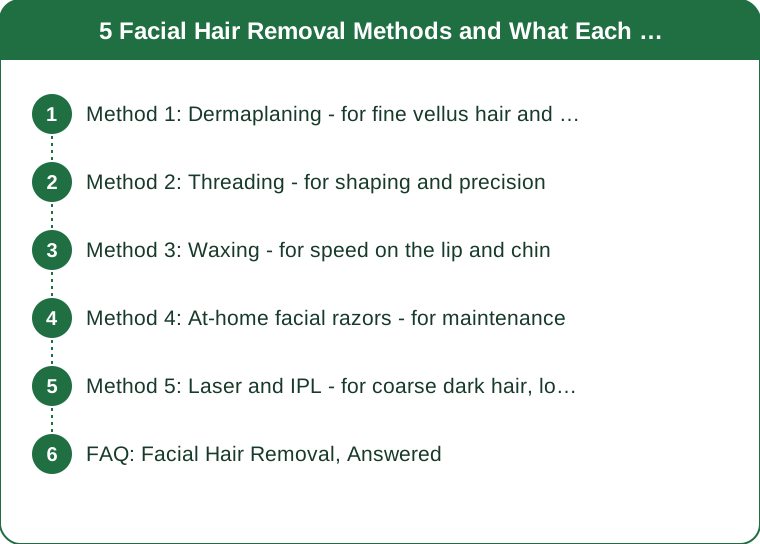
Method 1: Dermaplaning - for fine vellus hair and texture
What it is: a flat blade drawn across the skin at a shallow angle, removing fine vellus hair - the soft, pale hair on cheeks and jaw - along with the surface layer of dead skin.
What it suits: fine, light, downy hair over larger areas - cheeks, forehead, jawline. It is the only method on this list that also acts as a physical exfoliation, which is why makeup sits noticeably better afterwards.
What it does not suit: coarse dark terminal hair. On the upper lip or chin, a blade cuts the hair bluntly at the surface, and a thick hair with a blunt end feels stubbly as it regrows. It also does not suit active acne, rosacea flares, or inflamed skin - you will spread bacteria and irritate everything.
The myth to clear up: it does not make hair grow back thicker or darker. Cutting a hair does not change the follicle, and vellus hair does not become terminal hair because you shaved it. What changes is the feel - a blunt cut end feels coarser than a natural tapered tip.
The mistake people make: doing it too often. Every three to four weeks is plenty. Weekly dermaplaning removes the barrier faster than it rebuilds, and the result is sensitivity, redness, and breakouts.
Aftercare: nothing active for 24-48 hours. No acids, no retinol, no strong vitamin C. Sunscreen the next day without exception - you have removed the top layer and the skin underneath burns easily.
Method 2: Threading - for shaping and precision
What it is: a twisted cotton thread rolled across the skin, catching and lifting hairs out at the root, several at a time in a line.
What it suits: brows above all, plus the upper lip, chin, and sideburn area. The precision is the point - a practitioner can take a single row of hairs, which no other method can do. It also suits people who react to wax, since nothing is applied to the skin at all.
What it does not suit: large areas - it is slow. And very short hair, which the thread cannot catch. You need about two to three weeks of growth.
Why it is good for sensitive and mature skin: no product, no adhesion, and nothing pulls at the skin itself. Wax grips the skin as well as the hair, which is why it can lift and irritate; thread only catches hair. This matters more as skin gets thinner with age, and for anyone using retinoids.
How long it lasts: three to five weeks, as with any root removal.
The mistake people make: going to whoever is nearest. Threading is entirely operator-dependent and a good practitioner is dramatically better than an average one - both for shaping and for how much it hurts. Find one and stay with them.
On pain: it is sharp but brief, and the upper lip is genuinely the worst area. It gets much more tolerable after two or three sessions.
Method 3: Waxing - for speed on the lip and chin
What it is: warm or hard wax applied and removed with the hair, pulling from the root.
What it suits: the upper lip and chin, where it is fast and effective, and the sides of the face for larger areas of coarse hair. Hard wax is the right choice for the face - it grips the hair rather than the skin, which is exactly the distinction that matters on delicate areas. Strip wax belongs on legs.
What it does not suit: skin on retinoids or acids. This is the single biggest risk on the face, and it is serious - wax on retinoid-thinned skin can lift the skin itself, leaving a raw patch that takes a week or more to heal. Stop retinoids for five to seven days and acids for three before facial waxing, without exception.
Also not suitable: during active breakouts, on sunburn, or on very fragile mature skin.
How long it lasts: three to five weeks.
The mistake people make: waxing too close to an event. Expect redness for two to twenty-four hours and occasional small bumps. Book at least two days ahead of anything that matters.
Aftercare: nothing active for 48 hours, no heat - no hot shower, sauna, or intense workout for 24 hours - and sunscreen. Freshly waxed facial skin pigments easily, and post-inflammatory marks on the upper lip are stubborn and slow to fade.

Method 4: At-home facial razors - for maintenance
What it is: a small single-blade or eyebrow razor used dry or with a light gel, essentially at-home dermaplaning without the professional technique.
What it suits: maintenance between other treatments, quick tidying of stray hairs, and shaping brow edges. It is the cheapest, fastest, least dramatic option on this list and it is genuinely useful for that.
What it does not suit: anyone wanting lasting results. Regrowth is one to three days, and on coarse dark hair the stubble is more noticeable than the hair was.
Why people are afraid of it and should not be: the thicker and darker myth again. It does not change the follicle. The stubble sensation is real; the change in hair is not.
The mistakes people make: using a body razor on the face - the blade angle and guard are wrong and you will nick yourself. Using a blunt blade, which drags and irritates. And going over the same area repeatedly, which is the fastest route to razor burn on facial skin.
How to do it properly: clean dry skin, hold the skin taut, short strokes at about a 45 degree angle, in the direction the hair grows, and never repeat over the same patch. Replace the blade every three to four uses - they are cheap and a dull blade is the main cause of irritation.
Aftercare: a plain gentle moisturiser, nothing active for 24 hours, and sunscreen.
Method 5: Laser and IPL - for coarse dark hair, long term
What it is: light energy absorbed by pigment in the hair, damaging the follicle over a course of sessions. Laser is more targeted and more effective; IPL is broader and gentler, including home devices.
What it suits: coarse, dark hair on light skin is the classic best case, though modern lasers work across a much wider range of skin tones. The chin, jaw, and upper lip are the most common facial areas, and it is genuinely the only option here that reduces hair permanently rather than temporarily.
What it does not suit: white, grey, blonde, or red hair - there is not enough pigment to absorb the energy, and no device works well on it. It also does not suit anyone unwilling to commit: facial areas need six to ten sessions, four to six weeks apart, plus maintenance.
The seasonal point, and it matters: you cannot laser recently tanned skin, and you must avoid sun exposure on the treated area throughout. Autumn and winter are the correct time to start a course - which is exactly why clinics fill up from September. If you have been thinking about it, now is the window.
The mistakes people make: plucking or waxing between sessions. You must leave the root in place for the laser to target - shaving only, between appointments. And skipping the patch test, which is genuinely important on the face.
A caution: facial hair growth that is new, rapid, or accompanied by other changes is worth discussing with a doctor rather than only treating cosmetically. This is general information, not medical advice.
FAQ: Facial Hair Removal, Answered
Does removing facial hair make it grow back thicker?
No. Cutting or removing a hair does not change the follicle that produced it. The blunt regrowth feels coarser, which is where the myth comes from.
How long should I stop retinol before waxing or threading?
Five to seven days for waxing, three for threading, and three for acids. This is the most important rule in facial hair removal and the most commonly ignored.
Which method is best for sensitive skin?
Threading, because nothing touches the skin but thread. Then a clean sharp facial razor. Waxing is the most likely to react.
What about ingrown hairs on the face?
Less common than on the body but they happen on the chin and jaw. A gentle chemical exfoliant twice a week between treatments - not scrubbing - is the best prevention.
Can I do more than one method?
Yes, and most people do - dermaplaning for the cheeks, threading for brows, laser for the chin. Just space them out and do not treat the same area with two methods in the same week.
Is now a good time to start laser?
Yes. Reduced sun exposure through autumn and winter is exactly what a course needs, and starting now means results by spring.
TL;DR:
- Dermaplaning: fine vellus hair and texture, every 3-4 weeks, not on active acne.
- Threading: precision and shaping, best for sensitive and mature skin, entirely operator-dependent.
- Waxing: fast on lip and chin, use hard wax, and the retinoid rule is non-negotiable - it can lift skin.
- Facial razors: cheap maintenance, replace the blade every few uses, never repeat over the same patch.
- Laser or IPL: the only lasting option, needs coarse dark hair and 6-10 sessions - and autumn is the right time to start.
- Universal rules: stop retinoids and acids beforehand, no heat for 24 hours, sunscreen afterwards.
The mistake almost everyone makes once is treating the face like the legs. Thinner skin, daily sun exposure, and active skincare mean the same method behaves completely differently up there.
Keep Reading
This article is for general informational and styling purposes only. Fit, sizing, and product availability may vary.