5 End-of-Summer Hair Removal Resets Worth Doing Now
Quick Answer: Late summer is the best window of the year to reset a hair removal routine because sun exposure is winding down, laser and IPL become safe again as tans fade, and skin has accumulated the ingrown hairs, razor dullness, and dryness that summer reliably produces. These five resets — replacing blades, switching to a slower method, restarting exfoliation, treating existing ingrowns, and booking laser now rather than in December — set up an autumn with noticeably less irritation.
Summer hair removal is fast, frequent, and done under time pressure. That’s a recipe for dull blades, skipped prep, and a crop of ingrown hairs you’ve been ignoring since July.
The good news is that everything summer makes harder, autumn makes easier — if you reset in the right order.

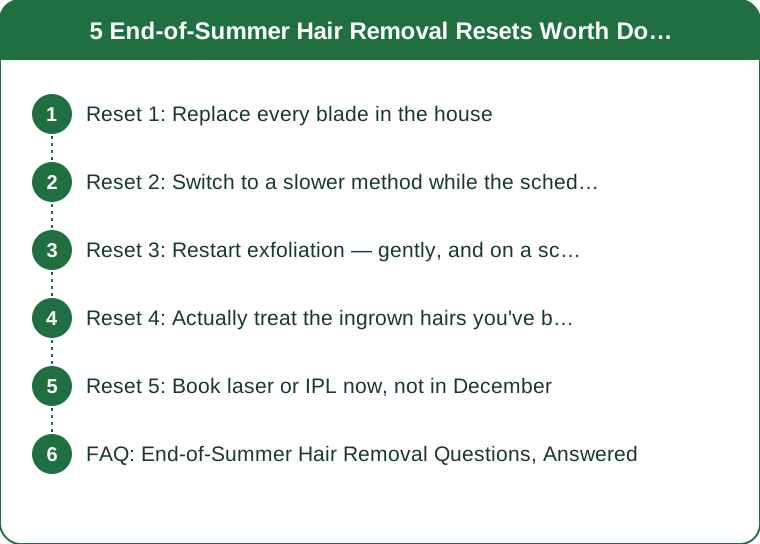
Reset 1: Replace every blade in the house
A razor blade is dull after five to seven shaves, and summer shaving frequency means yours is past that by a wide margin.
Dull blades are the direct cause of most razor burn. A sharp blade cuts hair cleanly at skin level with one pass. A dull one drags, requires pressure, and needs three passes over the same area — which is a description of how to irritate skin.
Heat and humidity accelerate blade degradation. A razor left in the shower through a humid summer corrodes faster than the same blade in a dry winter bathroom. The cartridge in your shower right now is probably older, in effective terms, than the number of shaves suggests.
Store the new one outside the shower. A dry surface away from steam roughly doubles blade life, which pays for itself within one pack.
Rinse and shake dry after each use — don’t wipe on a towel. Wiping bends the blade edges microscopically, and that’s a meaningful part of why blades dull.
Do the same for epilator heads and trimmer blades. Both dull, both get ignored, and both pull rather than cut when past their life.
Reset 2: Switch to a slower method while the schedule allows
Autumn is when the pressure to be smooth every single day drops, and that’s exactly when a longer-lasting method becomes practical.
Waxing and sugaring need 2 to 3 weeks of growth to work well — an impossible ask in July, entirely reasonable in October under jeans and long sleeves. The growing-out period is the barrier, and autumn removes it.
Results improve with repetition. Wax and sugar pull the hair from the follicle, and repeated cycles over several months produce finer regrowth for many people. Starting in September means arriving at next summer several cycles in.
Epilation follows the same logic and has the steepest comfort curve — the first three sessions are genuinely uncomfortable and the fifth is usually fine. Autumn is when you can afford to get through that curve.
If you stay with shaving, at least change the timing. Evening shaving instead of morning gives skin overnight to recover before it meets friction from clothing.
Don’t switch methods on multiple areas at once. Change one area, see how your skin responds over three cycles, then expand. Switching everything simultaneously means you can’t tell what caused a reaction.
Reset 3: Restart exfoliation — gently, and on a schedule
Summer skin gets exfoliated by accident — sand, chlorine, sunscreen removal — and then abruptly doesn’t. That gap is where ingrown hairs form.
Chemical over physical. A 2% salicylic acid or a glycolic lotion, two to three times a week, does more for ingrown prevention than any scrub. Salicylic acid is oil-soluble, so it gets into the follicle where the problem actually is.
Timing matters: exfoliate the day before hair removal, not the same day. Same-day exfoliation plus a blade or wax on already-sensitized skin is a reliable route to irritation.
Physical exfoliation has one good use — a soft dry brush or exfoliating mitt, light pressure, before showering. Anything aggressive enough to feel like it’s working is too aggressive.
Start at once a week and build up. Skin coming off a summer of sun exposure has a compromised barrier, and jumping straight to three times a week produces the stinging that makes people quit.
Don’t exfoliate over active ingrowns or broken skin. That’s the next reset, and it’s a different treatment.

Reset 4: Actually treat the ingrown hairs you’ve been ignoring
Most people have three or four dormant ingrowns by the end of summer and treat none of them, which is how they become dark marks that last a year.
Warm compress, twice daily, five minutes. Softens the skin over the trapped hair and often releases it without any intervention. This is the first step and it’s frequently the only one needed.
Salicylic acid directly on the spot after the compress. It dissolves the keratin plug holding the hair under the surface.
Do not dig. Tweezing out an ingrown by breaking the skin creates the scarring and dark spots that persist far longer than the bump. If it isn’t visible at the surface, it isn’t ready.
Stop removing hair in that area until it clears — usually 5 to 10 days. Shaving over an ingrown reliably makes it worse and often adds a second one.
For the dark marks left behind, which are post-inflammatory hyperpigmentation rather than scars: a niacinamide or azelaic acid product, daily, plus sunscreen on exposed areas. These fade over 3 to 6 months with treatment and considerably longer without.
If a bump is painful, growing, or has spread, that’s beyond ingrown territory and worth having looked at. This is general information, not medical advice.
Reset 5: Book laser or IPL now, not in December
Laser and IPL work by targeting pigment in the hair, which means a tan is a direct safety problem — and September through November is the clearest window of the year.
Most providers require 2 to 4 weeks with no sun exposure or self-tanner before treatment. That’s achievable in autumn and a genuine obstacle in June.
A full course is 6 to 8 sessions spaced 4 to 6 weeks apart — roughly 8 months. Starting in September means finishing before next summer. Starting in December means finishing during it, which is the worst possible schedule.
The sessions themselves are safer on untanned skin. Treating tanned skin raises the risk of burns and pigment changes, especially on medium and deeper skin tones. A reputable provider will refuse to treat a fresh tan, and that refusal is a good sign.
Between sessions, shaving is the only permitted method. No waxing, no epilating, no plucking — all of them remove the follicle target the laser needs. This is the rule people break most often and it’s why courses fail.
Expect a realistic outcome: significant, lasting reduction, not permanent total removal. Maintenance sessions once or twice a year are normal, and any provider promising permanence is overselling.
FAQ: End-of-Summer Hair Removal Questions, Answered
How long do I need to wait after a sunburn to remove hair?
Until the skin has fully healed and there’s no redness or peeling — usually 7 to 14 days for a mild burn. Shaving over sunburned skin damages an already-compromised barrier, and waxing on it can remove skin.
Can I switch from shaving to waxing straight away?
You need 2 to 3 weeks of growth first, about a quarter of an inch. Going in with shorter hair means the wax can’t grip properly, which produces a painful session with poor results and puts people off permanently.
Is IPL at home worth it compared to professional laser?
Home IPL devices are lower-powered, which means slower results and more sessions, but they’re genuinely effective for light skin with dark hair and cost far less over time. They work poorly on light or grey hair and carry more risk on deeper skin tones.
How do I stop razor burn on the bikini line specifically?
Sharp blade, shave with the grain rather than against it, minimal pressure, and a fragrance-free moisturizer immediately after. Most bikini line irritation is the combination of a dull blade and shaving against growth direction.
Does hair really grow back thicker after shaving?
No. Shaving cuts the strand at its widest point and leaves a blunt tip, which feels coarser as it grows out. The follicle is untouched and the hair’s actual thickness doesn’t change.
TL;DR: Autumn is the easiest hair removal window of the year — use it.
- Replace every blade. Summer frequency plus shower humidity means yours is well past its useful life.
- Switch to a longer-lasting method now, while the growing-out period is hidden under clothes.
- Restart exfoliation at once a week, chemical over physical, the day before removal rather than the same day.
- Treat the ingrowns you’ve been ignoring — warm compress and salicylic acid, and never dig.
- Book laser in September, not December. A full course takes about 8 months and needs untanned skin.
- Change one area at a time so you can actually tell what your skin is reacting to.
Start with the blades tonight. It costs the least, takes the least time, and eliminates more irritation than anything else on this list.
Keep Reading
This article is for general informational and styling purposes only. Fit, sizing, and product availability may vary.