5 Body Areas Where Hair Grows Back at Completely Different Speeds
Quick Answer: Hair growth rate and cycle length vary substantially by body area, which is why underarms need attention every few days and legs can go a week or more. The five zones behave predictably: underarms and bikini are fastest, face is fast but fine, legs are moderate, arms are slow, and the back and torso are slowest. Scheduling by zone rather than doing everything at once saves time and reduces irritation.
Most people remove hair on a single schedule and then wonder why some areas look regrown two days later.
Here are the five zones, what each one does, and what to actually do about it.

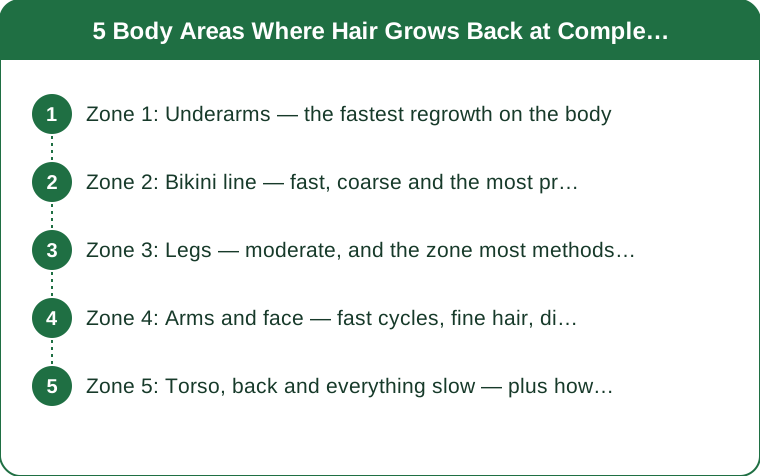
Zone 1: Underarms — the fastest regrowth on the body
What you see: stubble within one to three days of shaving, visible shadow by day two on darker hair, and a full return within about a week.
Why it behaves this way: underarm hair has one of the shortest growth cycles on the body. The anagen — active growing — phase is measured in weeks rather than the years that scalp hair spends growing, which means hair reaches its terminal length quickly and turns over fast. The hair is also coarse and dark relative to its length, so even a tiny amount of regrowth is highly visible.
Compounding factors: the area is warm, moist, constantly in motion and in contact with fabric and deodorant. Friction plus occlusion is also why underarms are the most common site for ingrown hairs and irritation after shaving.
What works best here: for shaving, every one to three days is realistic, always with a sharp blade and always in the direction that causes least irritation for you — the underarm has hair growing in several directions at once, which is why a single stroke direction never quite works. For waxing or epilation, expect two to four weeks between sessions, which is where the time saving is genuine.
The practical adjustment: wait a full 24 hours before applying antiperspirant after waxing or epilating, since the follicles are open and irritation is common. And exfoliate gently a couple of times a week rather than aggressively once, which is the schedule that actually reduces ingrowns.
Seasonally: this zone does not really change with the seasons, because it is maintained year-round regardless of what you are wearing. It is the one area where a longer-lasting method pays off in convenience rather than appearance.
Zone 2: Bikini line — fast, coarse and the most prone to problems
What you see: regrowth within two to four days of shaving, and the highest rate of ingrown hairs, bumps and irritation of any zone.
Why it behaves this way: the hair is coarse and often curly, and the follicles are set at angles that make curling back into the skin easy. Combine that with friction from clothing, warmth and moisture, and the ingrown hair risk is structurally higher than anywhere else.
The specific mechanism of ingrowns: cutting hair at or below the skin surface leaves a sharp tip; coarse curly hair then re-enters the follicle wall or the surrounding skin as it grows. That is why shaving very close is counterproductive here even though it feels like the goal.
What works best: waxing and sugaring remove the hair from the root and typically give three to five weeks, and many people find far fewer ingrowns than with shaving because the regrowing hair emerges with a tapered tip rather than a cut one. Trimming rather than shaving completely is a genuinely underrated option for reducing irritation.
If you shave here: shave at the end of a shower when hair is softened, use a fresh blade, do not stretch the skin taut, and go with the grain rather than chasing closeness. A dedicated post-shave product with a mild chemical exfoliant is more effective than physical scrubbing.
Timing note that matters: skin sensitivity in this area varies across the menstrual cycle, and waxing in the days immediately before a period is noticeably more painful for many people. Scheduling a few days after is a small change with a real effect.
As autumn arrives, this is the zone most people relax on, which is entirely reasonable. What is worth maintaining regardless is the exfoliation routine — ingrown hairs from grown-out hair under tighter winter clothing are a common and avoidable annoyance.

Zone 3: Legs — moderate, and the zone most methods are designed around
What you see: noticeable regrowth in three to five days from shaving, a full return in one to two weeks, and about four weeks between waxing sessions.
Why it behaves this way: leg hair has a longer growth cycle than underarm hair, so it turns over more slowly. It is also finer than bikini or underarm hair on most people, so early regrowth is less visible. The lower leg grows faster and coarser than the thigh, which is why the knee down needs more frequent attention than the knee up.
The largest practical variable is surface area. Legs take the longest to do, which means the method that suits them is whichever one you will actually complete rather than whichever is theoretically best.
What works best: shaving every three to five days is standard and fine. Epilating gives two to three weeks and is more tolerable on legs than on more sensitive zones. Waxing gives three to four weeks and is efficient over a large area.
Dryness is the real leg problem, not the hair. Shaving removes a layer of dead skin cells along with hair, and repeated shaving on already-dry skin is what produces the tight, itchy, flaky legs people associate with winter. Moisturising immediately after, on damp skin, does more for how legs look than the hair removal itself.
The seasonal shift is genuine here. From now into autumn, most people extend the interval as legs are covered more often. The trap is that longer gaps plus drier heated air plus hot showers produce more irritation when you do shave. Reducing frequency is fine; skipping the moisturiser is what causes the problem.
Zone 4: Arms and face — fast cycles, fine hair, different rules
What you see on arms: slow visible regrowth, often two weeks or more before it is noticeable, because the hair is fine and usually lighter.
What you see on the face: genuinely fast growth — facial hair has a short cycle and, on the upper lip and chin, can be visible within days — but the hair is often fine enough that the visibility depends heavily on colour and lighting.
Why arms are slow to show: arm hair is finer, shorter at its terminal length, and grows at a modest rate. Many people do not remove arm hair at all, and where they do, the interval is comfortably long.
Why the face needs its own approach: facial skin is thinner, more sensitive, more visible, and subject to sun exposure and skincare actives. Methods that are fine on legs can cause real problems here. Anything applied to the face needs care around retinoids and acids in particular — waxing or epilating skin that has been using a retinoid can lift skin, and most guidance suggests pausing retinoid use for several days beforehand.
What works on the face: dermaplaning, threading, waxing and depilatory creams formulated for facial skin all have their place. The one persistent myth to dismiss is that removing facial hair makes it grow back thicker — it does not. Cut hair has a blunt tip which feels coarser, and that sensation is the entire basis for the belief.
Hormonal factors matter more here than anywhere else. Increased facial hair growth can relate to hormonal conditions such as PCOS, and a genuine change in facial hair growth pattern is worth discussing with a doctor rather than only managing cosmetically.
Sun exposure interacts with facial hair removal specifically. Freshly waxed or exfoliated facial skin is more sun-sensitive, and this matters year-round rather than only in summer.
Zone 5: Torso, back and everything slow — plus how to schedule the whole thing
What you see: the slowest regrowth on the body, with intervals of several weeks between visible growth on the back, chest and stomach.
Why it behaves this way: these follicles have longer resting phases and produce hair more slowly. The trade-off is that the hair is often coarse where it does grow, and the areas are difficult to reach and easy to irritate.
What works best: for reachable areas, any method works on a long interval. For the back specifically, professional waxing is the practical answer since it is one of the few areas genuinely difficult to do yourself.
And now the point of the whole article — scheduling by zone.
Stop doing everything at once. The instinct is a single session covering all areas, which means the fast zones are neglected within days and the slow zones are being treated long before they needed it. Treating skin that does not need it is a direct route to irritation.
A workable rotation: underarms as needed on a short cycle. Bikini on its own interval. Legs weekly or fortnightly depending on the method. Face on its own schedule and with its own products. Torso and back monthly or less.
Group by method rather than by day. If you wax, book the areas whose cycles happen to align. If you shave, do the fast zones in the shower and the slow ones on a separate, less frequent occasion.
Track it once and you will not need to again. Two weeks of noting when each area actually needs attention gives you a personal schedule that is far more accurate than any general guidance, because growth rate varies enormously between individuals with hormones, age, genetics and ethnicity.
One rule that applies to every zone: exfoliate gently and regularly, moisturise after, and never remove hair from irritated skin. Almost every hair removal complaint traces back to one of those three.
This is general information, not medical advice — persistent skin reactions, infected ingrown hairs or a marked change in hair growth pattern are worth a professional opinion.
TL;DR:
- Underarms and bikini turn over fastest — days, not weeks — because the growth cycle there is short and the hair is coarse.
- Legs sit in the middle at roughly a week; lower legs grow faster than thighs.
- Arms are slow to show; the face grows fast but needs its own gentler method and a pause from retinoids.
- Back and torso are slowest of all, and the back is the one area genuinely worth outsourcing.
- Stop treating everything on one schedule. Treating skin before it needs it is the main cause of irritation.
Track for two weeks when each zone actually needs attention. Your own numbers beat every general guideline.
Keep Reading
This article is for general informational and styling purposes only. Fit, sizing, and product availability may vary.